
Let me tell you something that might go against everything you think you know about business.
Your biggest competitor might actually be your biggest opportunity.
I know. Bear with me.
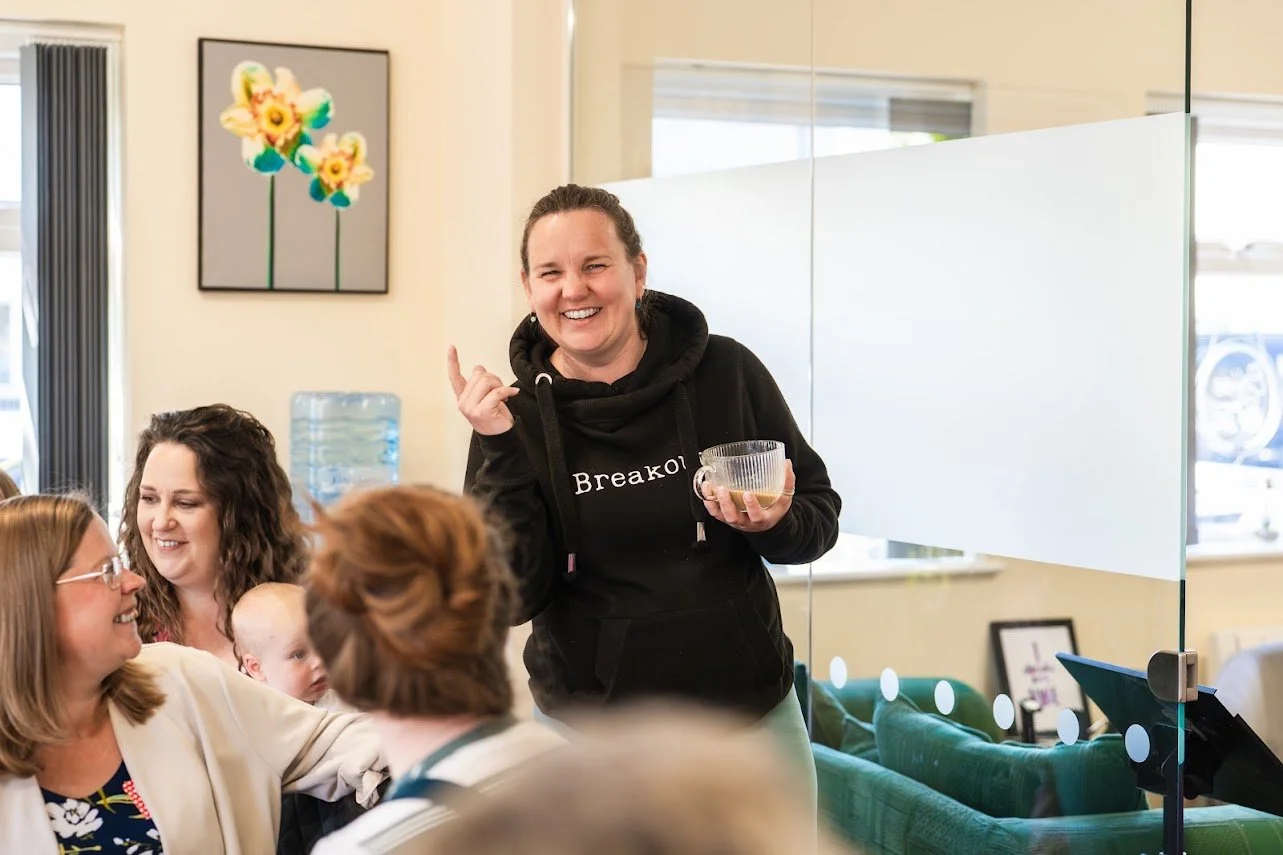
This week on the podcast I sat down with Farley from Breakout for Business in Sudbury — someone who, on paper, operates in a similar space to me. She runs networking events. She supports small business owners. She helps people with the practical side of running a business. We could absolutely be competitors.
Instead, we are each other’s biggest cheerleaders. We recommend each other constantly. We shout each other out. We have never exchanged a single penny.
And both of our businesses are better for it.
Our conversation was so honest and energising — and I want to share everything we talked about, because I genuinely believe that if more women in business embraced collaboration over competition, all of our businesses would grow faster.
1. You cannot copy someone else into success
Let’s start with something a little uncomfortable.
In the early days of Women Inspired Network, another group copied our content. The same ideas. The same types of reels. The same captions, sometimes word for word. For six months, we were putting out almost identical content.
It worked for us. It didn’t work as well for them.
And that is not a coincidence. Because what people are connecting with when they engage with your content is not the words — it’s you. Your personality. Your energy. The way you show up. The experience people have when they actually walk through the door.
Farley said it brilliantly: “You can copy me all you like but you’re not going to be me. You can copy someone else’s social media, but I’m not going to walk in and have the same experience. And if your experience in real life doesn’t match the experience on social media, you will very quickly lose people.”
Copying is not a strategy. It’s a shortcut that leads nowhere. The only thing that actually works long-term is being completely, unapologetically yourself.
2. There is more than enough to go around
One of the biggest myths in business is that if someone else wins, you lose. That if another networking group does well, there are fewer people for yours. That if another VA gets a client, there’s one less client for you.
It’s just not true.
There are enough people in your area, in your industry, in your niche, who need what you offer. Not everyone is your client — and that’s okay. Different businesses appeal to different people. Different networking groups suit different personalities. The woman who loves my events might not be right for Farley’s, and vice versa. And that’s exactly as it should be.
When you operate from a mindset of scarcity — that there isn’t enough to go around — you become defensive, protective and competitive. And that energy repels people.
When you operate from a mindset of abundance — that there is more than enough for everyone — you become generous, collaborative and connective. And that energy attracts people.
Farley doesn’t lose business because I exist. I don’t lose business because Farley exists. We send each other business. That’s what happens when you let go of competition.
3. Even people in the same industry are rarely doing the same thing
Here’s something worth sitting with: even when two businesses look identical from the outside, they’re almost never actually the same.
Farley and I both run networking events. But she does mixed gender, evening events. I do women-only, daytime events. We attract completely different people and serve completely different needs. Those aren’t competitors — they’re complements.
The same is true in almost every industry. Two VAs might both do admin, but one specialises in construction businesses and one in creative entrepreneurs. Two photographers might both do portraits, but one focuses on newborns and one on branding shoots. Two bookkeepers might both use accounting software, but one knows QuickBooks inside out and one is a Xero expert.
Before you write off someone as a competitor, get curious about them. Ask what they do, how they work, who they serve. You might find that you’re actually serving completely different markets — and that you can refer each other rather than fight each other.
Farley does this naturally. She told me that even when she’s in a room with someone who does exactly what she does, she goes to them first and asks questions. She finds the nuance. She looks for the opportunity to complement rather than compete.
4. Word of mouth is the most powerful marketing there is — and it only comes from relationships
I’ve said it before and I’ll say it again. It’s not the people in the room — it’s the people they know.
Farley gets asked all the time: do you know someone who does this? Because she knows so many people across so many industries, she almost always has an answer. And when she does, she refers without hesitation. Because she genuinely wants to help. And because the people she refers have been good to her.
That’s word of mouth marketing in action. And it is worth more than any paid ad, any viral reel, any email campaign. Because it comes with trust already built in.
But here’s the thing about word of mouth: it only flows between people who have real relationships. You cannot manufacture it. You cannot buy it. You can only earn it — by showing up, being genuinely interested in other people’s businesses, being kind, being generous, being the kind of person that other people want to champion.
As Farley put it: “If you’re absolutely bloody lovely and chatting to people, they’re going to recommend you”
5. Networking should never be about selling — it should be about connecting
This is something Farley and I feel very strongly about and it came up a lot in our conversation.
Networking is not a sales event. It is the beginning of a relationship. And relationships — real ones — cannot be rushed or forced.
When you walk into a networking event and immediately try to sell to people, you create the same feeling as receiving a cold DM from a stranger asking if you want to buy their product. It’s jarring. It’s uncomfortable. And it doesn’t work.
What does work is being genuinely curious about the person in front of you. Asking about their business. Listening. Finding the connection. And trusting that if you’re the right fit for each other, the business will follow naturally when the time is right.
Farley described it as awareness and the start of a relationship. You go to networking to get on people’s radar. To become the person they think of when someone in their network needs what you do. That doesn’t happen from a pitch. It happens from a conversation.
6. Kindness is a business strategy
I’ll be honest — this is the part of business that nobody ever puts in a marketing course, but it might be the most important thing I’ve learned.
Being nice to people works. Genuinely, consistently, without an agenda, being kind to the people around you — it comes back to you. Not always immediately. Not always in an obvious way. But it comes back.
Farley and I have recommended each other to hundreds of people. We have never paid each other a penny. No affiliate arrangement, no formal agreement. We just like each other and we think the other person is brilliant at what they do. So we say so.
As Farley’s husband says: it’s nice to be nice.
And as I always say: kindness leads to connection. Connection leads to collaboration. And that’s where the magic happens.
A note on networking etiquette
Since we’re being honest — there are a few things worth saying clearly.
If you come to a networking event, please don’t use it to promote a competing networking group. The person running the event has spent years building that community. It’s not the place to recruit people away from it.
If you’re part of someone’s Facebook community, please don’t advertise your own competing business in it without asking first. That community was built with time and effort and love. Respect it.
And if you’re inspired by what someone else is doing — tell them. Be inspired. Take ideas and make them your own. But don’t copy content word for word. Don’t replicate someone else’s message and pass it off as yours. It’s not just bad etiquette — as we’ve already established, it doesn’t even work.
We are all better when we lift each other up. 💛
About Farley
Farley runs Breakout for Business in Sudbury — a co-working space and business support centre offering help with websites, bookkeeping, social media and everything else that comes with running a small business. She also runs evening networking events in Sudbury and is looking for guest speakers — so if you support small businesses and fancy getting in front of a brilliant room, get in touch!
Find Farley here:
🌐 https://breakoutservices.co.uk
📸 Instagram: https://www.instagram.com/breakoutforbusiness
👤 Facebook: https://www.facebook.com/BreakoutForBusiness
Want to hear the full conversation?
Listen to my full chat with Farley on the Women Inspired Networking Conversations podcast, available now on Spotify and Apple Podcasts.
🎙️ Spotify: https://open.spotify.com/show/0DM7Ooc5nLezg4u91OklYo?si=83acff1303aa4471
📺 YouTube: https://youtube.com/playlist?list=PLDVCZqf8LiBs92aTeEHZsWrtoNRJEVCXn&si=kfsbmnaQYm0lelUk
Come and find your people:
🌐 www.womeninspirednetwork.com/events
👤 Facebook: Women Inspired Network: Networking For Women In Business
📸 Instagram: @women_inspired_network