
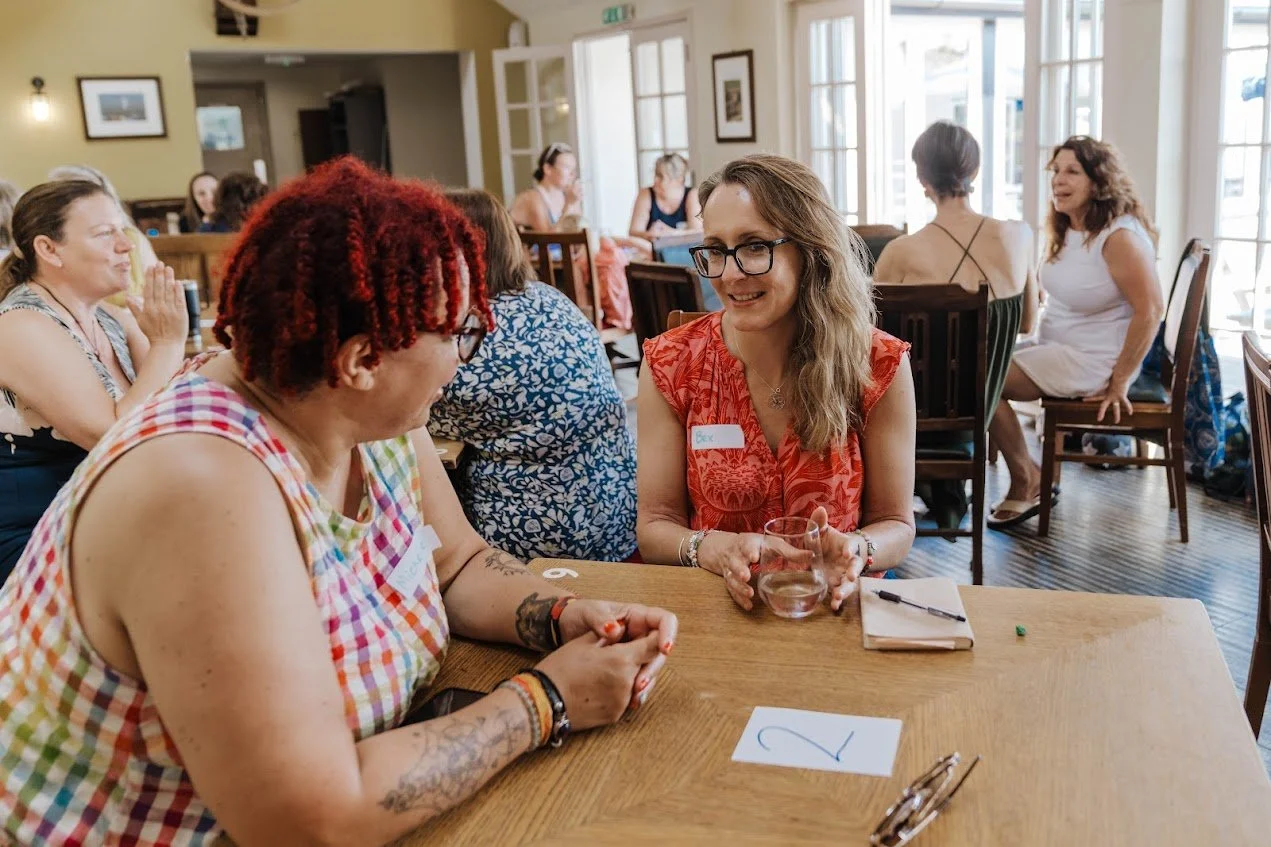
If the thought of walking into a room full of strangers and talking about yourself makes you want to cancel and go home, this one is for you.
Julie Clarke is a family and wedding photographer who moved to the UK from North Carolina in 2021. She arrived knowing nobody, had to rebuild her business from scratch in a brand new country, and describes herself as a complete introvert. The kind of person who thrives in one-to-one conversations but finds group chats overwhelming.
Her first ever networking experience was in the US. There was wine. She drank some to hype herself up. She talked to about two people. She left having made no real connections and feeling like networking just wasn’t for her.
And then she came to a WIN event.
Before the event had even officially started she found herself deep in a conversation about childhood trauma with two women she’d never met. By the end she’d made more genuine connections in two hours than she’d made in years of staying in her photography industry bubble.
Julie’s story is a brilliant reminder that networking doesn’t have to feel like performing. And that the most powerful connections you’ll ever make in business might come from the most unexpected places.
Here’s what she taught me.
1. Being an introvert is not a barrier to networking — it’s actually a superpower
Introverts are often told that networking isn’t for them. That it requires a level of outgoing energy they just don’t have. That they’ll always struggle in a room full of people.
Julie completely dismantles that idea.
“I am such an introvert that I can’t do group chats,” she told me. “But I do really well with one-on-one conversations. That’s just where I thrive.”
Introverts are often brilliant listeners. They ask thoughtful questions. They make people feel genuinely heard. They don’t dominate conversations — they contribute meaningfully to them. In a one-to-one networking setting, those qualities are not weaknesses. They are exactly what builds real connection.
The key is finding a networking format that plays to your strengths rather than forcing you into one that doesn’t. Not all networking is the same. If standing up and pitching to a room of twenty people fills you with dread, that format is not for you. But small group conversations? One-to-one speed networking? A relaxed, guided format where someone tells you exactly what to talk about so you don’t have to figure it out on the spot? That might change everything.
2. The right format makes all the difference
Julie’s first networking experience in the US was exactly the format that doesn’t work for introverts. Everyone standing in groups. No structure. No direction. Just an expectation that you’ll walk up to strangers and start talking.
For a lot of people — not just introverts — that is genuinely terrifying. And it’s why so many people decide networking isn’t for them after one bad experience.
But Julie made a really interesting observation about why WIN works differently. She compared it to how she approaches her photography.
“It’s gently guided,” she said. “You’re not just being thrown into this sea of people that you don’t know and expected to walk up to them and talk. Someone is telling you here’s what you’re going to do, here’s what you’re going to talk about. And then before you know it you’ve made all these amazing connections.”
That gentle guidance removes the paralysing question of what do I say? It gives you a starting point. And once you have a starting point, conversation flows naturally.
If you’ve had a bad networking experience before, please don’t let it put you off forever. Try a different format. Find one that suits how you naturally interact with people. The right room will feel completely different to the wrong one.
3. Networking builds confidence in talking about what you do — even if it takes time
This is something Julie said that really resonated with me.
For a long time, when she met new people, she defaulted to saying she was a nanny. It felt safer. Less vulnerable. Less open to judgment than saying she was a photographer and putting her creative work on the line.
“It took me a long time to be like, I’m a photographer,” she told me. “Being a nanny felt safe because it was established. Whereas photography, I’m constantly having to put myself out there and look for new clients.”
So many women in business feel this. The reluctance to claim the title. The fear of saying what you do and having someone not be interested, or worse, be dismissive. It can feel easier to downplay it, hedge around it, or avoid saying it altogether.
But networking — done consistently, in a safe and supportive environment — builds that muscle. Every time you say it out loud, it gets a little easier. Every time someone responds with genuine interest or says they know someone who needs exactly what you do, you feel a little more confident. Every time you leave an event buzzing, you remember why you’re doing this.
Say it. Own it. You are a [whatever you are]. Say it with your whole chest.
4. Stop only networking within your own industry
This is the one that I think could genuinely transform your business if you let it.
Before WIN, Julie had mostly networked with other photographers. Which is brilliant for learning, for industry knowledge, for peer support. But it has one obvious limitation: other photographers are not your clients.
Coming to a mixed networking group changed everything. She met Abby, who is now helping her with her marketing. She met women who needed branding shoots. She met potential clients for family sessions, people who could refer her for weddings, and connections she never would have made if she’d stayed in her photography bubble.
“I’m getting to know other people who do all the different things that I’m not equipped at doing,” she said. “I wouldn’t have been able to find them if I was just still stuck in my photography, wedding industry world.”
Think about who is actually in the room at a mixed networking event. There are potential clients for almost every business. There are people with networks full of the exact customers you’re looking for. There are collaborators who could add real value to what you offer. There are people who need you — they just haven’t met you yet.
Your industry peers are valuable. But they are not your only network. Get out of the bubble.
5. When you show up consistently, people start to recognise your work
Julie photographs many of our WIN events. And something really interesting has started to happen — people are beginning to recognise her photos before they even know she took them.
One of our members told her recently: “I can always tell when it’s your photos. You have such a clear, defined style and colouring. It’s very warm and cosy.”
That recognition doesn’t happen overnight. It happens because Julie shows up consistently, because her work is seen regularly by a growing community of women, and because she has developed a style so distinctive that it becomes recognisable.
The same principle applies to you, whatever your business. When people see you regularly — at events, in the group chat, in the directory, in the photos from the event — you become familiar. And familiar becomes trusted. And trusted becomes booked.
Consistency of presence is one of the most underrated marketing strategies there is.
6. The pre-event chat is where some of the best connections happen
Julie’s best connections at her first WIN event didn’t happen during the structured networking. They happened in the few minutes before the event officially started, when people were still arriving and settling in.
She ended up in a deep conversation about childhood trauma with two women she’d never met. And those became some of her most valued connections.
I always say this — get there early. Those unstructured few minutes before things kick off are where people are most relaxed, most themselves, and most open to genuine conversation. Nobody is in “networking mode” yet. They’re just people having a chat.
And for introverts in particular, arriving early means you can ease in gradually rather than walking into a room that’s already buzzing and trying to find your way in.
A final thought
Julie moved to a brand new country knowing nobody. She had to rebuild her business, her reputation and her network completely from scratch. She is an introvert who was terrified of networking. And she has built genuine, meaningful connections that have directly grown her business — all by finding the right room and showing up consistently.
If you’ve been telling yourself that networking isn’t for you, that you’re too introverted, too niche, too new, too quiet — Julie’s story is your sign to try again. Just find the right room. 💛
About Julie
Julie Clarke is a family and wedding photographer based in Suffolk, specialising in capturing warm, natural moments that tell the story of your family. She also offers branding shoots for business owners who want photos that truly reflect their personality. Julie is our wonderful new WIN leader in Mildenhall, with her first event on 13th August at Riverside House Hotel.
Find Julie here:
🌐 Website: https://julieclarkephotography.com/
📸 Instagram: @julieclarkephotography
👤 Facebook: https://www.facebook.com/julieclarkephoto
Want to hear the full conversation?
Listen to my full chat with Julie on the Women Inspired Networking Conversations podcast, available now on Spotify and Apple Podcasts.
🎙️ Spotify: https://open.spotify.com/show/0DM7Ooc5nLezg4u91OklYo?si=83acff1303aa4471
📺 YouTube: https://youtube.com/playlist?list=PLDVCZqf8LiBs92aTeEHZsWrtoNRJEVCXn&si=kfsbmnaQYm0lelUk
Come and find your people:
🌐 www.womeninspirednetwork.com/events
👤 Facebook: Women Inspired Network: Networking For Women In Business
📸 Instagram: @women_inspired_network